
Understand What Shapes Each Online Table-Game Result
Online table games can show a live dealer and equipment or use software to determine outcomes, so the result-producing mechanism differs by format.
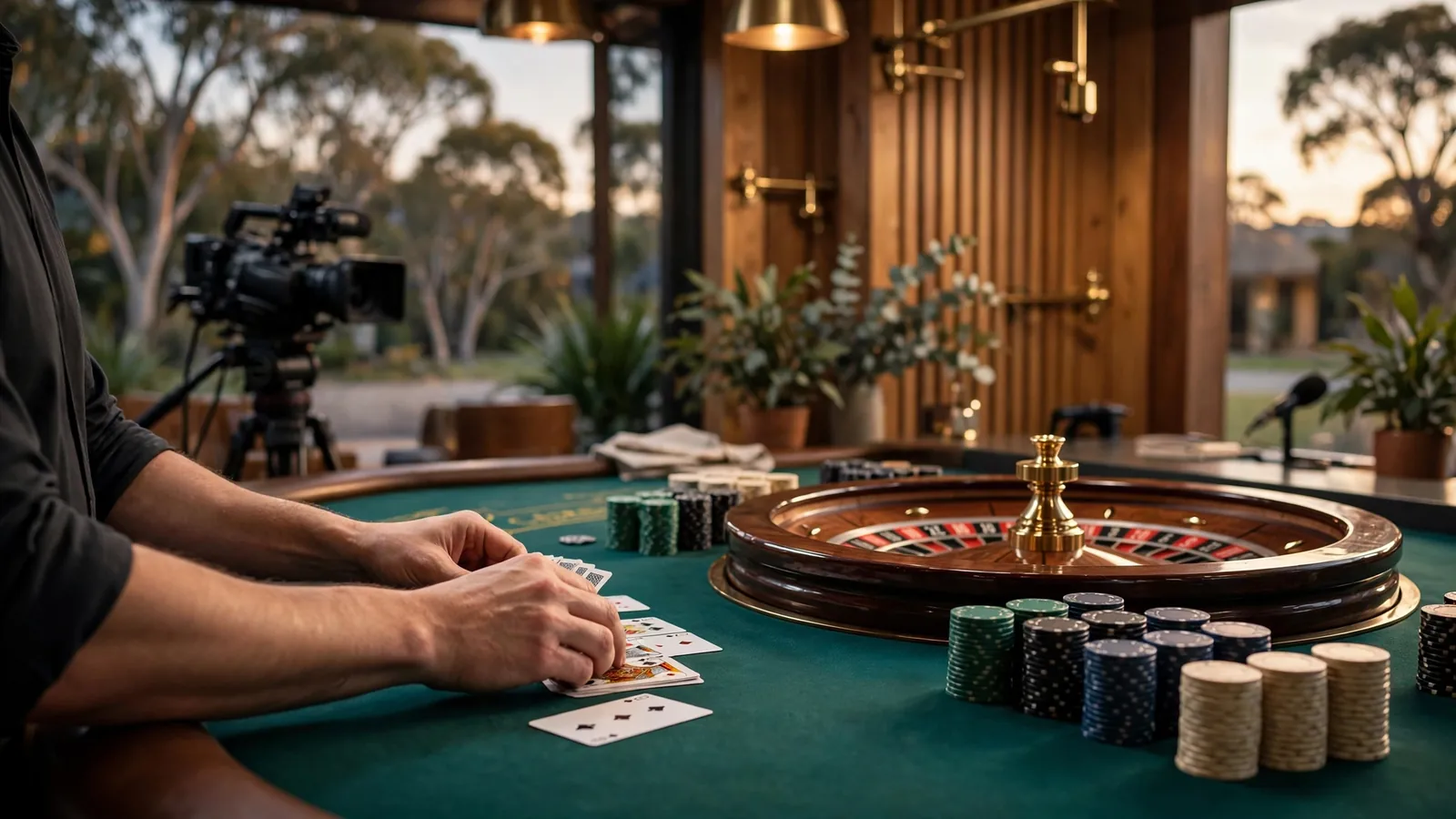
Table of Contents
- How Online Table Games Work
- Bitcoin Payments and Table-Game Access
- What the Available Facts Say About Table-Game Odds
- How Play Differs Across Table Games
- Finding Table Games Near You: What This Evidence Can Establish
- What Counts as a Casino Table Game?
- Table-Game Formats and Their Distinguishing Features
- Card-Based Table Games: What the Facts Establish
- Roulette Formats and the Zero Pockets
- Poker at the Table: The Objective of the Game
How Online Table Games Work
Online table games can be presented through two different mechanisms. In a live-dealer format, a real dealer operates casino equipment while a video feed of the session is streamed to participants. In a software-generated format, a random number generator determines the outcome within the game: for example, which cards are dealt or where a roulette ball lands. Both may be displayed through an online interface, but the source of the result differs.
A live stream shows an actual dealer and equipment rather than a wholly software-rendered table. The digital interface connects the streamed activity with the game’s online presentation. By contrast, software-generated play does not depend on a visible dealer handling cards or a wheel in front of a camera; the random number generator supplies the outcome. These distinctions describe how the formats produce or present a result, not whether either format is suitable or lawful in a particular jurisdiction.
The term “real-money” describes play involving money rather than a purely non-monetary presentation. It does not change the mechanics of a live stream or a random number generator. Nor does a game’s appearance establish that it is available legally to people in every location. A table shown online may resemble a physical casino table, but its visual presentation is separate from the legal status of the service supplying it.
Top operators
Choosing real-money table games in Australia means weighing the operator details available to you before you play. This overview offers a concise reference to the listed operators and the specific information provided about each.
-
DragonSlots Casino
- License
- Curacao Gaming Authority (Jumpman Gaming Ltd)
DragonSlots Casino is listed with a Curacao Gaming Authority license held by Jumpman Gaming Ltd.
-
SpinsUp
- License
- Curacao Gaming Control Board OGL/2023/174/0082 (Dama N.V.)
SpinsUp is listed with a Curacao Gaming Control Board license, OGL/2023/174/0082, held by Dama N.V.
-
JeetCity Casino
- License
- Curacao eGaming (Dama N.V.)
JeetCity Casino is listed with a Curacao eGaming license held by Dama N.V.
-
Roby Casino
- License
- Curacao eGaming (Roby Games Ltd)
Roby Casino is listed with a Curacao eGaming license held by Roby Games Ltd.
-
Neospin
- License
- Curacao Gaming Control Board OGL/2023/176/0095 (Hollycorn N.V.)
Neospin is listed with a Curacao Gaming Control Board license, OGL/2023/176/0095, held by Hollycorn N.V.
-
Rollero Casino
- License
- Curacao Gaming Control Board OGL/2023/176/0095 (Hollycorn N.V.)
Rollero Casino is listed with a Curacao Gaming Control Board license, OGL/2023/176/0095, held by Hollycorn N.V.
-
Kingmaker
- Payout speed
- crypto ~90 minutes, fiat 1-5 days
- Min. deposit
- A$30
Kingmaker lists crypto payouts at around 90 minutes and fiat payouts at 1–5 days. Its minimum deposit is A$30.
-
SkyCrown
- License
- Tobique Gaming Commission
- Payout speed
- crypto ~10-15 minutes, fiat 1-5 days
- Min. deposit
- A$30
SkyCrown is listed with a Tobique Gaming Commission license. Its stated payout times are around 10–15 minutes for crypto and 1–5 days for fiat, and its minimum deposit is A$30.
-
Ricky Casino
- Payout speed
- crypto under 1 hour, PayID 1-3 business days
- Min. deposit
- A$20 (A$30 to qualify for the bonus)
Ricky Casino lists crypto payouts in under an hour and PayID payouts in 1–3 business days. The minimum deposit is A$20, or A$30 to qualify for the bonus.
-
Thor Casino
- License
- Curacao – Antillephone N.V. (Versus Odds B.V.)
- Min. deposit
- EUR 20
Thor Casino is listed with a Curacao license held by Antillephone N.V. (Versus Odds B.V.). Its minimum deposit is EUR 20.
Live-dealer and software-generated formats
In live-dealer play, the dealer and casino equipment are real, and the session reaches participants as streamed video. The stream is therefore part of the game’s presentation. It should not be confused with a computer animation that depicts a dealer or table. The defining feature is the use of a real dealer and equipment, with the activity transmitted live.
Software-generated table games use a random number generator to select outcomes. In a card game, it determines the cards dealt; in roulette, it determines where the ball lands. The outcome is produced by software rather than by a physical event shown through a live camera. The interface may still use familiar table imagery, but that imagery does not mean that physical equipment is involved.
These formats can be distinguished without making assumptions about the quality or reliability of a particular service. A stream establishes that a real dealer and equipment are being shown; it does not, by itself, establish every aspect of a platform’s operation. Likewise, describing a game as software-generated explains the stated role of its random number generator, not the legal permission to offer it in Australia.
The two mechanisms also should not be treated as interchangeable descriptions. A live-dealer game depends on a streamed session involving a person and real equipment, whereas a software-generated game relies on a generator to determine the relevant outcome. Both can be delivered through a digital interface, but the interface alone does not reveal which mechanism is being used. The distinction concerns the origin and presentation of game outcomes, not a ranking of formats.


Australia’s legal context
The mechanics of online casino table games sit within a restrictive Australian legal framework. The Interactive Gambling Act 2001 prohibits operators from providing real-money online casino games to people located in Australia. This applies to casino-style interactive services, rather than being a distinction that can be avoided by presenting a table through streamed video instead of software. A live dealer does not, by virtue of being a real person, place the service outside that framework.
The Act also bars Australian-based businesses from offering real-money interactive casino games to residents. The Australian Communications and Media Authority is responsible for enforcement and blocks unlicensed domestic platforms. In practical terms, the existence of an online interface or a technically accessible game does not establish that its provision complies with Australian law.
An offshore location does not create a general exception permitting online casinos to serve people in Australia. The relevant legal question concerns the provision of the service to someone physically located in the country, not simply where the operator or its equipment is situated. Consequently, descriptions of international platforms or their game formats should not be read as confirmation that real-money play is lawful or endorsed for Australian audiences.
This context matters when interpreting terms such as “online casino table games” or “live casino.” They identify ways a game may be presented, but they do not establish a lawful route to real-money participation in Australia. The format distinction remains a technical one: a live dealer and streamed equipment on one side, software-generated outcomes on the other. The legal restriction applies to the provision of real-money online casino games to people in Australia regardless of that distinction.
Bitcoin Payments and Table-Game Access
Bitcoin is a payment method, not a table-game format. The term “bitcoin table games” can therefore refer to two separate things: a game played online and a payment method associated with an account. The payment method does not, by itself, establish what games a service offers, whether a particular table is available, or how a game operates.
Nor does the use of Bitcoin change the legal position in Australia. Under the Interactive Gambling Act 2001, operators are prohibited from providing real-money online casino games to people located in Australia. Casino-style offerings such as blackjack, roulette and poker fall within that restriction. The Australian Communications and Media Authority enforces the rules and blocks unlicensed domestic platforms. A payment method cannot turn a prohibited service into a lawful one, and an offshore payment arrangement should not be read as approval for Australian residents to use an online casino.
There is a narrower point concerning withdrawals. A specialist review reported that Bitcoin withdrawals processed within 10–30 minutes, with the stated timing dependent on blockchain confirmations rather than banking processes. That is a claim from one review, not a stable estimate for all services or transactions. It does not establish how long a particular withdrawal will take, and it says nothing about the availability or performance of table games. Processing times can also be subject to change, so the figure should not be treated as a guarantee.


This distinction matters when comparing Bitcoin-based access with other payment arrangements. A reported withdrawal interval concerns the movement of funds, not the rules, interface or results of a game. It cannot show that Bitcoin provides access to more table games, that tables remain open at particular times, or that one payment method offers better conditions. Those claims require evidence about the specific service and its games; a withdrawal-time statement does not supply it.
The same limitation applies to requests for the best Bitcoin casino table games or the best table games for Bitcoin. A payment label does not rank games, identify a best choice, or reveal which tables accept a given method. Nor does it establish that a service is operating lawfully for people in Australia. Treating Bitcoin as a shortcut to a recommendation would combine separate questions—payment processing, game availability and legal status—without establishing the link between them.
Likewise, “Bitcoin table games versus normal casino table games” is not a comparison of game mechanics. Bitcoin describes a payment context; “normal” does not define a distinct category of table game. Any meaningful comparison would need to specify what is being compared, such as the rules of a game or the terms attached to a payment method. The reported withdrawal timing alone supports neither a general advantage nor a disadvantage.
Searches for felt-table games, top casino tables or tables currently open also concern matters that a withdrawal report cannot answer. A transaction estimate does not identify a venue, list available tables, or confirm that a particular game can be accessed from Australia. These are separate questions from how a payment is processed.
Accordingly, Bitcoin-related claims should be read narrowly. The reported processing interval is an attributed, time-sensitive statement about withdrawals and blockchain confirmation. It is not evidence of Australian access to real-money casino tables, a comparison with other payment methods, or a basis for naming the best table game.
What the Available Facts Say About Table-Game Odds
A table game’s basic objective does not, by itself, establish whether it offers favourable odds. In blackjack, for instance, the player competes with the dealer to make a hand value closer to 21. That describes the contest, but it does not specify the probability of a particular result or the amount paid when a bet wins. A comparison based only on the game’s aim would therefore not support a reliable ranking.
Odds depend on more than the name of a game. A meaningful comparison requires the rules that govern play, the available bets, the probability of each relevant outcome and the payout attached to it. The relationship between these elements determines how a wager performs over repeated play. Without that detail, a statement that one table game has better odds than another would go beyond what the mechanics alone can show.
The same distinction applies to bets on a hand, the Banker’s hand or a tie. These are different betting choices, but naming them does not reveal how likely each outcome is or what each bet pays. The existence of several options is not evidence that one is more advantageous. Nor does a list of possible bets amount to a house-edge chart: such a chart would need a defined set of rules and calculations for each bet being compared.

“Best odds” and “worst odds” are consequently not labels that can be assigned from a game’s broad category or objective alone. A table-game odds comparison needs to specify what is being measured. The chance of winning a single wager is not necessarily the same measure as the expected financial result over repeated wagers. Payouts also matter: a less frequent outcome may carry a different return from a more frequent one. Any ranking that does not distinguish these measures risks presenting unlike quantities as though they were comparable.
A house-edge comparison has similar requirements. It is a calculation tied to rules and wager conditions, not a general property that can safely be inferred from a game’s name. A chart that omits those conditions can give an impression of precision while concealing the assumptions behind its figures. For a responsible comparison, the rules and calculation method must be stated alongside the result.
Accordingly, blackjack’s stated aim and the named hand, Banker and tie bets describe aspects of play, not a ranking of casino table games by odds. They do not establish which game has the best odds, which has the worst, or what any particular house edge is. No conclusion about a best option follows from those mechanics alone.
This distinction is also separate from the legal status of online casino play in Australia. The Interactive Gambling Act 2001 prohibits operators from providing real-money online casino games to people located in Australia, including table games. The Australian Communications and Media Authority enforces the law. Describing betting mechanics or the limits of odds comparisons should not be read as an endorsement or invitation to participate.
How Play Differs Across Table Games
The basic actions in blackjack, dice-based table play and poker are different: one centres on a hand measured against a target, another on the result of a dice roll, and the third on constructing a strong hand. These distinctions describe the games’ broad aims, not a ranking of which is preferable.
In blackjack, a player competes with the dealer. The aim is to finish with a hand value closer to 21 than the dealer’s. The central comparison is therefore between two hands and their respective values. This gives blackjack a clear numerical target, while the opposing hand belongs to the dealer. It is not a contest among players to form the strongest hand, as in poker, nor is its central action a wager on a dice result.
Dice-based table play begins with rolling a pair of dice and betting on the outcome. The roll supplies the event on which the wager is placed. In that respect, the activity differs from blackjack’s hand-versus-dealer comparison and from poker’s emphasis on building a hand. The defining sequence is simple at this level: a pair of dice is rolled, and the bet concerns what happens as a result. Further detail about particular wagers or rules depends on the specific game and is not needed to distinguish this basic format.
Poker, by contrast, has players competing to build the best possible hand. Its central objective is hand construction within a contest between players. That differs from blackjack, where the stated opponent is the dealer and the target is a value closer to 21, and from dice play, where the wager concerns the result of a roll. The shared word “hand” does not make the games equivalent: in blackjack, its value is assessed against the dealer’s; in poker, players seek the strongest possible hand.


These contrasts can help classify table games by the action that defines them. Blackjack asks how a player’s hand value compares with the dealer’s in relation to 21. Dice-based play places the focus on a roll and its outcome. Poker centres on players building hands in competition.
In Australia, the legal setting is also relevant to any discussion of real-money play. The Interactive Gambling Act 2001 prohibits operators from providing real-money online casino games, including table games, to people located in Australia. The distinction between blackjack, dice-based play and poker therefore describes their basic gameplay, not an invitation or endorsement to access them for money.
Finding Table Games Near You: What This Evidence Can Establish
A location-based request for a casino with table games depends on details such as the venue’s address, whether it is open, and which games it offers. A result for another country, such as Miami or Ohio, would not answer a question about a venue near someone in Australia.
The distinction between a physical venue and an online service also matters. Australia’s Interactive Gambling Act 2001 prohibits operators from providing real-money online casino games to people physically in the country. This prohibition covers online casino-style games such as blackjack, roulette and poker. The legal position does not establish where a land-based casino is located, what it offers, or whether it is close to a particular person.
The Australian Communications and Media Authority enforces the rules and blocks unlicensed domestic platforms. Accordingly, an online listing or offer should not be treated as evidence that a real-money casino service is legally available in Australia. Nor does the fact that offshore platforms may accept Australian players make them local venues or establish their proximity. The legal framework and a physical-location search answer different questions.
A useful description of a nearby venue would need to connect a place with current, specific information: its location and its table-game offering. Without that connection, a general reference to casino table games cannot support a claim that a venue is nearby. The same applies to claims about a new casino or newly available table games. Such descriptions require evidence about the venue and its current offering; the phrase alone provides neither.
This limits what can responsibly be said about the nearest casino with table games in Australia. The same restraint applies to recommending a destination: proximity and availability cannot be inferred from general descriptions of casino games or the law governing online services.
The location-based question therefore remains specific to a person’s area and to the status of individual venues. General information about online gambling law cannot determine either point. It can establish that real-money online casino services are prohibited for operators serving people in Australia, while leaving physical venue locations and offerings unconfirmed. A nearby-casino claim should be made only when both the location and the table-game availability are supported by current, relevant information.
What Counts as a Casino Table Game?
A casino table game is a category of casino game associated with play organised around a table or its equivalent in a digital interface. The label describes the game format, but it does not establish how an online result is produced. In online settings, the key distinction is between a live-dealer presentation and an outcome generated by software.

In a live-dealer game, a real dealer uses casino equipment, and a video stream carries the action to players. The screen therefore shows a live event rather than a sequence of images standing in for one. This format is still online play: the dealer and equipment are at the casino, while the player views the stream remotely.
A software-determined version works differently. A Random Number Generator (RNG) determines the result, such as the cards dealt or the point at which a roulette ball lands. The interface may depict familiar casino equipment, but the displayed outcome is generated by the system rather than captured from a live dealer’s table. The visual resemblance between formats does not make their underlying processes the same.
These distinctions provide a practical definition of online casino table games without requiring a complete catalogue of titles. The term can cover games presented through a live stream as well as digital versions whose outcomes come from an RNG. It is therefore useful to ask what determines the result, rather than relying only on how the game looks on screen. A digital table graphic alone does not show whether a real dealer is involved.
The word “software” can also refer to systems used to manage casino operations, but that is separate from the question of what constitutes a table game. The defining point here is the game’s presentation and outcome process: a live dealer with real equipment and streamed video, or a software-generated result. A management system is not, by itself, a game format.
Live-Dealer Format
A real dealer operates equipment while a video feed is streamed to participants.
Software-Generated Format
A random number generator (RNG) determines the outcome within the game.
In Australia, this definition is descriptive, not an endorsement or an indication that real-money online play is lawful. The Interactive Gambling Act 2001 prohibits operators from providing real-money online casino games, including table games, to people physically located in Australia. The distinction between live-dealer and RNG formats does not alter that legal position. Nor does describing a game as a table game imply that an online service offering it is authorised for Australian residents.
Accordingly, “casino table game” is best understood as a broad category, not a claim about where a game is offered, who may provide it, or whether a particular service can lawfully accept Australian customers. The format distinction identifies how an online game’s action is presented and how its outcomes are determined; it does not settle questions of access or legality.
Table-Game Formats and Their Distinguishing Features
Table games can be grouped by the equipment and outcome around which play is organised. A wheel, cards or dice create different kinds of decisions and define what participants are trying to predict or achieve. This is a practical way to distinguish formats, rather than a complete catalogue of every game available.
Wheel-based play
Roulette centres on a ball landing in a numbered pocket on a spinning wheel. The main online versions are European, French and American roulette. Their layouts are not identical: European and French wheels have numbered pockets alongside a single green zero, while the American wheel includes both a zero and a double zero. These variations distinguish the formats even though their shared central feature is the spinning wheel.

Games played with cards
Blackjack is organised around a player’s hand and the dealer’s hand. The aim is to finish with a hand value closer to 21 than the dealer’s. Poker also uses hands, but its stated objective is different: players compete to form the strongest possible poker hand. The distinction is therefore not simply that both are card games; blackjack sets a player against the dealer, while poker describes competition among players.
Some card-based games also allow bets on different hands or on a tie. In that structure, the wager concerns which hand will prevail—or whether the outcome will be a tie—rather than building the best poker hand. These mechanics provide a broad way to recognise card-game formats without treating them as interchangeable.
Dice-based play
A dice format is built around rolling a pair of dice and placing bets on the outcome. Unlike roulette, the result comes from dice rather than a wheel and ball. Unlike the card formats, the central event is a roll, not the comparison or construction of hands. That difference gives the format a distinct structure, even when the particular bets available are not specified.
These categories describe mechanics, not a ranking of games or a claim that one format is preferable. They also do not establish which formats are available through any particular service. In Australia, the Interactive Gambling Act 2001 prohibits operators from providing real-money online casino games, including table games, to people located in the country. The mechanics can be described separately from the legality of offering such games.
Card-Based Table Games: What the Facts Establish
Card-based casino table games do not all share the same objective.
In blackjack, the player’s hand is measured against the dealer’s: the stated aim is to finish with a value closer to 21 than the dealer’s hand. The game is therefore characterised by a player-versus-dealer objective, rather than by a wager on which of several named hands will prevail.
Card Game Objectives
Blackjack involves a player-versus-dealer contest to reach a value closer to 21, while poker is a player-versus-player competition to build the strongest hand. Some card games also allow wagers on the player's hand, the Banker's hand, or a tie.
A separate betting arrangement allows a wager on the player’s hand, the Banker’s hand or a tie. The presence of a Banker option should not be taken as evidence that every casino card game uses this structure.
Poker has a different emphasis: players compete to build the best possible hand. Poker is therefore best distinguished here by its player-versus-player contest over hand strength, rather than grouped with blackjack’s contest against a dealer.
These broad categories help clarify what “card table game” can refer to: a comparison with a dealer, a wager on one of several hand outcomes, or a contest among players to assemble a strong hand.
The legal context matters in Australia. Under the Interactive Gambling Act 2001, providing real-money online casino games, including blackjack and poker, to people physically located in Australia is prohibited. The game descriptions above are therefore explanations of terminology and objectives, not an invitation or recommendation to participate in online casino gambling.

Roulette Formats and the Zero Pockets
Roulette is offered in several formats, with European, French and American versions among the main ones. Their most clearly established mechanical distinction is the arrangement of the zero pockets. European and French roulette each have 36 numbered pockets and one green pocket marked 0. American roulette has a green 0 pocket and an additional green 00 pocket.
That difference gives the American layout an extra pocket; the names alone do not indicate a different aim or a separate kind of table game.
European and French roulette
The European and French versions share the same stated pocket arrangement: 36 numbered spaces and a single green zero. On that basis, the two formats cannot be told apart by the number of pockets or by whether the wheel includes a zero.
American roulette
The American version has a green pocket for 0 and another for 00, alongside its numbered pockets. The double-zero pocket is the defining layout feature that separates it from the European and French arrangements described above. A table or game labelled American roulette therefore has a different zero-pocket structure, even though it remains a roulette format.

These distinctions matter when identifying which version is being presented: European and French roulette have one green zero, while American roulette has both 0 and 00. They do not, by themselves, establish other rules or outcomes.
Online offerings include these named versions, but the labels should be read as descriptions of format rather than as evidence of a particular advantage. The pocket layout is the concrete point of comparison: one green zero in European and French roulette, and two green zero-designated pockets in American roulette.
Poker at the Table: The Objective of the Game
Poker is defined by competition between players to build the best possible hand. The objective is therefore comparative: a hand is assessed in relation to the hands held by others, rather than solely against a dealer or a fixed target. This central aim distinguishes poker as a contest among players, even though the exact rules and hand-building process can vary between forms of the game.

The phrase *casino poker table games* covers poker played in a casino setting, but it does not identify one uniform format. Pai gow poker, for instance, should not be assumed to follow any particular procedure based on its name alone. A title may signal a distinct format, while the details of how hands are formed and compared depend on the rules attached to that game.
The idea of building the strongest hand also does not, by itself, establish which hand ranks above another or how a round is resolved. Those details require the rules of the specific form being played. That is the defining objective, rather than a claim about a particular strategy, outcome or advantage.
The legal setting in Australia is separate from this description of poker’s objective. Under the Interactive Gambling Act 2001, operators are prohibited from providing real-money online poker to people located in Australia. Accordingly, describing poker as a casino table-game category does not imply that real-money online casino poker is legally offered to Australian residents.
Can you play table games online for real money?
Not through a service lawfully provided to people in Australia: the Interactive Gambling Act 2001 prohibits operators from offering real-money online casino games to people located there.
What is the legal status of online table games for Australian players in 2026?
The Interactive Gambling Act 2001 prohibits operators from providing real-money online casino games to people in Australia, whether the games use a live dealer or software-generated outcomes. ACMA enforces the rules and blocks unlicensed domestic platforms.
Are online casinos legal in Australia?
Operators are prohibited from providing real-money online casino games to people in Australia under the Interactive Gambling Act 2001. An operator being based offshore does not, by itself, make the service lawful for people located in Australia.
Prepared by the Rizspin Casino editorial staff.