
Separate the search phrase from verifiable casino details
The phrase may describe gaming-machine facilities, but it does not by itself name a venue, product or licence category.
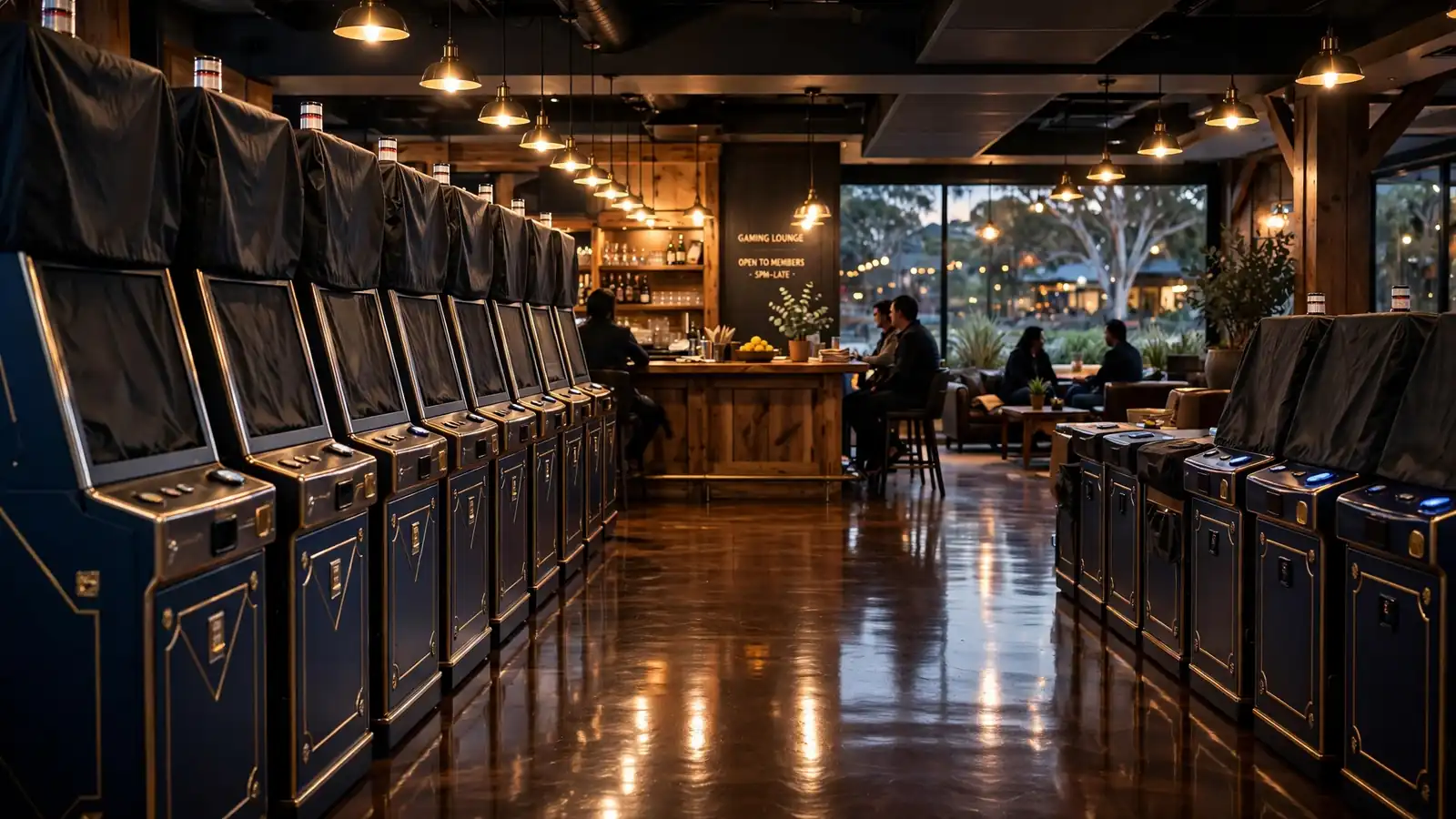
Table of Contents
- What “Pokies Parlour” Means in the Australian Casino Context
- Australian Casino Reviews: What the Available Evidence Can Establish
- The Australian Market Behind the Search Term
- Casino Access, Opening Hours and Location Details
- Parlour Pokies and the Casino Gaming-Machine Footprint
- Sign-Up Bonuses and Deposit Offers: What Can Be Verified
- Free Chips and Spins: Limits of the Available Information
- Pokies Parlour Online and Free-Play Searches in Australia
- Bonus Claims Beyond the Sign-Up Offer
- Real-Money Casino Searches and the Australian Regulatory Boundary
What “Pokies Parlour” Means in the Australian Casino Context
“Pokies parlour” is best read as an informal description of casino gaming machines or an area associated with them, not as the established name of a particular Australian venue, company or product. The words combine a familiar Australian term for gaming machines with “parlour”, which suggests a place or room. That wording alone does not identify a specific location or establish that a casino formally uses the label.
The distinction matters because a descriptive phrase can sound like a proper name when it is presented without context. An Australian casino may have gaming machines, but that does not mean its venue is called a pokies parlour. Nor does the phrase establish that there is a separate premises, a particular room layout or a distinct category of casino licence attached to it. Those details require evidence about an identifiable venue, rather than an inference from the wording.
In this context, “pokies” refers to gaming machines. “Parlour” contributes a sense of place, but it does not make the phrase precise. It may be used loosely to refer to a casino’s machine-gaming facilities, or simply as a general label for a casino experience centred on gaming machines. Without a named venue and supporting information, it is not possible to determine which meaning is intended in a particular use.
Top operators
Choosing an online pokies option in Australia means checking the details that matter to you, such as licensing, payment methods and stated deposit requirements. This list offers a concise reference for considering the operators featured for 2026.
-
DragonSlots Casino
- License
- Curacao Gaming Authority (Jumpman Gaming Ltd)
DragonSlots Casino is listed with a Curacao Gaming Authority license held by Jumpman Gaming Ltd.
-
SpinsUp
- License
- Curacao Gaming Control Board OGL/2023/174/0082 (Dama N.V.)
SpinsUp is listed with Curacao Gaming Control Board license OGL/2023/174/0082, held by Dama N.V.
-
JeetCity Casino
- License
- Curacao eGaming (Dama N.V.)
JeetCity Casino is listed with a Curacao eGaming license held by Dama N.V.
-
Roby Casino
- License
- Curacao eGaming (Roby Games Ltd)
Roby Casino is listed with a Curacao eGaming license held by Roby Games Ltd.
-
Neospin
- License
- Curacao Gaming Control Board OGL/2023/176/0095 (Hollycorn N.V.)
Neospin is listed with Curacao Gaming Control Board license OGL/2023/176/0095, held by Hollycorn N.V.
-
Rollero Casino
- License
- Curacao Gaming Control Board OGL/2023/176/0095 (Hollycorn N.V.)
Rollero Casino is listed with Curacao Gaming Control Board license OGL/2023/176/0095, held by Hollycorn N.V.
-
Kingmaker
- Payout speed
- crypto ~90 minutes, fiat 1-5 days
- Min. deposit
- A$30
Kingmaker lists a minimum deposit of A$30. Its stated payout times are around 90 minutes for crypto and 1–5 days for fiat.
-
SkyCrown
- License
- Tobique Gaming Commission
- Payout speed
- crypto ~10-15 minutes, fiat 1-5 days
- Min. deposit
- A$30
SkyCrown lists a Tobique Gaming Commission license and a minimum deposit of A$30. Its stated payout times are around 10–15 minutes for crypto and 1–5 days for fiat.
-
Ricky Casino
- Payout speed
- crypto under 1 hour, PayID 1-3 business days
- Min. deposit
- A$20 (A$30 to qualify for the bonus)
Ricky Casino lists a minimum deposit of A$20, with A$30 required to qualify for the bonus. Its stated payout times are under an hour for crypto and 1–3 business days for PayID.
-
Thor Casino
- License
- Curacao – Antillephone N.V. (Versus Odds B.V.)
- Min. deposit
- EUR 20
Thor Casino is listed with a Curacao – Antillephone N.V. license held by Versus Odds B.V. Its stated minimum deposit is EUR 20.
The phrase should also be kept separate from the broader idea of a casino. A casino is a venue category; “pokies parlour” is not, by itself, a reliable description of everything the venue offers. It does not establish which other facilities are present, how the premises are arranged, or what services are available. Equally, the phrase does not show that a venue offers only gaming machines. A label that foregrounds one feature cannot stand in for a complete account of a property.
The number of machines documented across Australian casinos gives the term a concrete setting without turning it into a venue name: 3,308 gaming machines are recorded as both endorsed on venue licences and installed in casinos nationally. That total concerns machines in casinos, not a count of places formally called parlours. It also does not imply that every casino has the same machine facilities or that the machines are gathered in a separately named area.
“Pokie parlour” is a close variant of “pokies parlour”, but the singular form does not make it more official or specific. Both expressions can function as informal descriptions. Likewise, “parlour casino” reverses the order of the words without resolving the ambiguity: it still does not identify a confirmed business or tell what facilities a particular site contains. A reader encountering any of these expressions should treat them as descriptive wording unless the surrounding material supplies an independently identifiable venue.


This distinction is especially important when a phrase appears in a heading, listing or promotional description. Repetition can lend an informal label the appearance of an official one, but repetition does not verify a venue’s name or status. A precise account would identify the actual casino and describe its facilities on evidence tied to that property. In the absence of those details, the phrase can only be interpreted at the general level of casino gaming machines.
The word “parlour” may evoke a dedicated room, but the term itself cannot verify the existence, size or arrangement of such a space. Casino layouts and facility descriptions are venue-specific. It would therefore be unwarranted to assume that every casino has a separately designated pokies room, or that an area informally described as a parlour has a standard design across the country. The phrase supplies no reliable basis for those conclusions.
For the same reason, the expression should not be treated as a synonym for every kind of gaming venue in Australia. Its wording points towards casino gaming machines, but it does not establish that a club, hotel or other premises is a casino, or that its facilities match those of one. The setting matters: the meaning here is limited to a casino context, and the phrase itself does not determine the regulatory or operational category of any particular venue.

Accordingly, “pokies parlour” is useful only as a broad topic label. It signals an interest in gaming machines in an Australian casino setting, while leaving the identity and characteristics of any specific venue unresolved. Reading it this way avoids mistaking informal wording for a verified casino name and keeps the discussion anchored to what the phrase can reasonably convey.
Australian Casino Reviews: What the Available Evidence Can Establish
A review of an Australian casino is only as reliable as the claims it makes and the evidence supporting them. A confident rating, polished description or repeated promotional phrase does not, by itself, establish how a venue is authorised or what it offers. More useful assessments distinguish documented facts from opinion and make clear where the available information stops.
The central structural fact is that casino regulation in Australia sits with state and territory governments. Each casino property operates under a licence issued by the jurisdiction in which it is located. This means that a general statement about an “Australian casino licence” can obscure an important distinction: authorisation is attached to a property and its local regulatory framework, rather than established by a national casino licence covering every venue.
That distinction gives a review a concrete point of reference. Claims about a casino’s regulatory position should identify the relevant property and jurisdiction, rather than relying on broad labels. A review that does not make this connection may still offer commentary, but its assessment of licensing cannot be evaluated from the wording alone. Likewise, a high score or favourable description is not a substitute for information about the basis on which that judgement was reached.


Reviews can also differ in purpose. Some describe a physical venue, while others use the language of a “pokies parlour” without making clear whether they mean a casino gaming area, another kind of gaming venue or an online service. The phrase should not be treated as proof that a particular named parlour exists or that it is a licensed operator. Where the subject is unclear, the review’s claims cannot safely be transferred from one kind of service to another.
A careful assessment therefore separates facts from interpretation. Statements about a property’s jurisdictional licensing structure are distinct from subjective impressions, promotional descriptions and unsubstantiated claims about quality. Even a detailed account remains limited if it does not identify what supports its assertions. Conversely, a review need not settle every question to be useful: it can accurately state a narrow, verifiable point while leaving other matters unresolved.
This approach also helps explain why several reviews can reach different conclusions without providing equivalent evidence. Ratings compress multiple judgements into a single result, but the score alone does not reveal which criteria were applied or whether the underlying claims were checked. Descriptive language may communicate an opinion; it should not be mistaken for confirmation of a regulatory fact.
Do
- Identify the specific venue and jurisdiction
- Distinguish documented facts from subjective opinion
- Base assessments on evidence tied to a property
Don't
- Rely on broad labels or promotional phrases
- Treat a high score as a substitute for evidence
- Transfer claims from one service type to another
The phrase “pokies parlour review” can thus cover materially different subjects. The relevant test is not whether a page sounds authoritative, but whether it clearly identifies the venue under discussion and distinguishes its supported statements from evaluation. In Australia, the state and territory licensing structure provides a firm basis for that distinction. Beyond it, conclusions should remain proportionate to the evidence presented, rather than inferred from ratings, labels or promotional wording.
The Australian Market Behind the Search Term
Australia’s gambling landscape is geographically broad, but figures describing its scale need to be read according to what they count and where they come from. A specialist review reports more than 20 full-scale casinos across all eight states. That is a reported market estimate, not a permanent count: venues and classifications can change, and the figure should not be treated as a census of every place where gambling is available.
The same specialist-review material places gambling in 147 Australian cities. This broader measure is not a count of casinos. “Gambling” can cover a wider range of facilities than full-scale casino venues, so the city figure cannot be used to infer how many casinos operate in each location. Nor does it show that every city has the same kind or scale of provision. It indicates geographic reach, rather than a uniform network of parlours.
At the city level, the review identifies Sydney, in New South Wales, as Australia’s largest gambling city and records 11 gambling facilities there. The category is described as gambling facilities, not casinos alone. The count therefore should not be restated as 11 casinos, or as a measure of gaming-machine capacity. It is a city-level comparison within that review’s chosen classification.
These figures offer different views of the market: one concerns full-scale casinos, another the number of cities where gambling is recorded, and another facilities within a particular city. They should not be combined as though they describe a single, consistently defined inventory. A count of cities does not establish the number of venues in each city; a facility count does not identify every facility as a casino; and a casino estimate does not account for all forms of gambling.
This distinction matters when interpreting the idea of a pokies parlour in an Australian setting. The phrase may evoke a local gaming venue, but national casino totals and city-level gambling counts describe the wider distribution of gambling, not a standard venue type found in every area. The figures do not establish that each reported facility has the same layout, services or machine provision.
The specialist review’s snapshot is therefore useful as broad geographic context, rather than as a definitive current register. Its reported national and city figures locate gambling activity across Australia while leaving the boundaries of each count important. In particular, the description of Sydney as the largest gambling city rests on the review’s tally of facilities; it does not, by itself, establish that Sydney has the greatest number of casinos or machines under another definition. The national picture is best understood through these separate measures, with their stated scope kept intact.
Casino Access, Opening Hours and Location Details
Physical casino access is governed by venue conditions as well as the broader entry rules. The minimum age for casino entry is 18 across Australia, and valid photo identification is required at major casinos. These requirements apply to entry; they do not establish access to every area or service within a property.
Major Australian casinos operate around the clock. That describes their general operating hours, not necessarily the hours of every restaurant, entertainment space or other facility on site. A continuous casino schedule also does not imply that all areas have identical entry conditions. References to a VIP parlour therefore concern a possible category of venue access, not a nationally standardised facility or a guarantee of particular privileges.
The locations of individual venues show how widely physical casino properties are distributed. Lasseters Casino is at 93 Barrett Drive in Alice Springs, in the Northern Territory. On the Queensland coast, Jupiters Gold Coast Casino & Hotel is situated on Broadbeach Island. Country Club Casino is listed on Country Club Avenue in Prospect, within Meander Valley, Tasmania. These addresses place the venues in distinct regional settings; they should not be read as evidence that each has the same layout or access arrangements.
For visits, the relevant distinction is between the casino’s general operating schedule and the conditions attached to entry and particular spaces. Age and identification requirements establish baseline access conditions, while the location identifies the physical property. A venue’s name or a description such as “VIP” does not, by itself, specify who may enter a particular area or what facilities it contains. Such details are property-specific and should be treated separately from the nationwide minimum age and the stated operating pattern of major casinos.
Parlour Pokies and the Casino Gaming-Machine Footprint
The documented national count of gaming machines installed in Australian casinos is 3,308. This figure refers to machines recorded as both installed and endorsed on venue licences; it is not a count of every gaming machine in Australia, nor does it describe machines in other types of gambling venue.
As an aggregate, the total indicates the scale of the casino machine footprint, but it does not show how that footprint is distributed. It cannot establish how many machines are present at any particular casino, whether venues have similar numbers, or what facilities are available at a specific property. The national figure should therefore not be read as a typical venue count.
The distinction matters when “parlour” is used to describe a casino’s machine area. The count supports a limited statement about the overall presence of licensed, installed machines in casinos. It does not verify that every casino has a separately designated parlour, or that the term describes a standard layout shared across the country. A national total cannot substitute for venue-specific information.
Nor does the count identify machine types, games, operating conditions or current availability at individual sites. Those details cannot be inferred from the total alone. The figure is best treated as a measure of the installed casino machine footprint, not as a guide to what a particular venue offers.
Sign-Up Bonuses and Deposit Offers: What Can Be Verified
A sign-up reward or deposit incentive is a promotional claim, not evidence that an online casino is authorised to serve people in Australia. A page may describe a welcome credit, a deposit match or a no-deposit reward, but the presence of those words does not change the legal status of the service. Nor does a displayed offer establish that its terms are accurate, current or available to people in Australia.
The regulatory boundary is decisive. Under the Interactive Gambling Act 2001, operators cannot lawfully provide real-money online casino games to people physically located in Australia. Casino-style services covered by the prohibition include online slots, poker and table games. A promotion attached to such a service does not create an exception: describing an incentive as a bonus, credit or free entry does not make the underlying service authorised.
This distinction matters because promotional language can make an online service appear routine. A page may present account registration and a deposit offer as ordinary steps, while the offer itself says little about whether the operator may provide gambling services in Australia. The number or attractiveness of the advertised benefits is therefore not a sound measure of regulatory standing.
Claims about an offer also need to be separated from facts about its terms. A headline can promise a reward, but that alone does not establish the conditions attached to it, whether it can be claimed by an Australian customer, or whether the service is legally permitted here. The wording of a promotion is evidence that a claim has been made; it is not independent confirmation that the claim is usable or that the operator is authorised.
Likewise, a website loading, displaying an account form or accepting account traffic does not establish Australian licensing. These are technical features of a website, not proof of lawful authority. The same applies when a service appears at an alternate domain. A changed web address may preserve access to a page, but it does not alter the rules governing the service offered to people in Australia.
Enforcement can also affect the visibility of gambling websites. The Australian Communications and Media Authority has taken website-blocking action against illegal gambling services, including domains associated with Fair Go. Blocking may affect which addresses resolve through Australian internet service providers, while alternate addresses can appear over time. Consequently, a domain that works at one point, or a replacement address that later becomes visible, cannot establish that the service is licensed or lawful.
These points also explain why a sign-up or deposit offer should not be treated as a reliable indicator of consumer protection. Promotional copy can describe benefits without establishing the operator’s legal status, and a functioning page cannot supply that missing proof. In Australia, the underlying service matters more than the label placed on its incentive: an offer attached to prohibited real-money online casino gambling does not make the gambling service permissible.
The distinction is between an advertised claim and an established regulatory fact. A banner may describe a reward; an account page may invite registration; a domain may remain accessible or change. None of those details overrides the prohibition on providing real-money online casino games to people in Australia. Any assessment of such a promotion must therefore begin with the legal status of the service, rather than the wording or apparent availability of its offer.
Free Chips and Spins: Limits of the Available Information
References to free chips or spins are promotional claims, not evidence that a particular offer exists or is available in Australia. No specific promotion can be established from those phrases alone. They do not identify an issuing venue or service, set out conditions, or demonstrate that the advertised benefit can be claimed.
The word “free” also needs careful interpretation. A promotion may be described as free while being conditional on an account, a qualifying action or other terms. Without the full offer conditions, it is not possible to establish whether a benefit has a cost, what restrictions apply, or whether any winnings can be withdrawn. These are questions for the actual terms, not details that can be inferred from a headline or banner.
A useful assessment would require an identifiable operator and a current, complete set of terms tied to the offer. The terms would need to explain who is eligible, how the benefit is issued, what conditions govern its use, and whether any limits apply to redemption. If those details are absent or cannot be connected to the claim, the promotion remains unsubstantiated. A page that repeats the words “free chips” or “free spins” does not resolve that uncertainty.
The wording also does not establish that an offer is specifically for a physical Australian casino. It may refer to an online service, a venue promotion, or merely general promotional language. Those are materially different contexts. A physical venue’s existence does not prove it runs a particular promotion, while a website displaying an offer does not establish that the service is authorised to provide online casino gambling in Australia.

This distinction matters because the Interactive Gambling Act 2001 prohibits operators from providing real-money online casino games to people physically located in Australia. Online casino-style services, including slots and table games, fall within that prohibition. Promotional language cannot alter the legal status of the underlying service. Nor does the absence of a charge to claim a benefit, by itself, establish that an online casino offer is lawful or available to Australian users.
The same evidentiary standard applies whether an advertisement uses “free play,” “chips,” or “spins.” A specific claim needs verifiable terms and a clear connection to the provider making it. Without those, no conclusion about eligibility, conditions, or practical availability is justified. The label alone is not proof of a genuine promotion, and it should not be treated as confirmation that a service is suitable for Australian residents.
Pokies Parlour Online and Free-Play Searches in Australia
Online access does not make a casino-style service lawful in Australia. The Interactive Gambling Act 2001 prohibits operators from providing real-money online casino games to people located in the country. The category includes online slots, poker and table games such as blackjack and roulette. A site’s description of itself as a parlour, casino or free-play destination does not change the legal framework that applies to the service it provides.
ACMA Enforcement
Federal oversight is managed by the Australian Communications and Media Authority (ACMA), which monitors compliance with the Interactive Gambling Act 2001. ACMA can investigate prohibited services and request that internet service providers block access to illegal gambling sites.
Federal oversight sits with the Australian Communications and Media Authority (ACMA). Its role includes enforcing the Act and monitoring whether online gambling services comply with federal law. Where a service provides prohibited interactive gambling or advertises it in Australia, ACMA can investigate and take enforcement action. The regulator can also ask Australian internet service providers to block access to sites that provide prohibited services or advertise them.
Blocking is one part of that enforcement framework. ACMA reports that enforcement actions have led to blocks affecting more than 1,455 illegal gambling and affiliate websites since November 2019. This figure concerns websites, not a count of individual operators or a measure of how many people tried to use them. The distinction matters because a service may appear through more than one web address, while enforcement can target websites associated with gambling activity.
The reported number of services that have withdrawn from the Australian market is less consistent. One account says more than 210 illegal services have withdrawn since ACMA began enforcing the rules in 2017; another gives a figure of over 190 for the same period. Those totals are in direct disagreement and should not be combined or presented as a single settled count. Both describe withdrawals following the start of enforcement, rather than the number of websites blocked.
A functioning website or an alternate domain is not evidence that an online casino is authorised to serve Australians. Website blocking can affect whether particular addresses resolve through Australian internet providers, and alternate addresses may appear over time. That technical change says nothing, by itself, about whether the underlying service complies with the law. Nor does a domain’s accessibility establish that its operator has approval to provide online casino gambling in Australia.

The same distinction is relevant to free-play descriptions. A no-cost label alone does not establish what a service offers, how it operates or whether it falls within the rules governing interactive gambling. A page may use free-play language while also promoting a prohibited gambling service. The legal assessment concerns the service and its conduct, not merely the wording used in a heading or advertisement. Consequently, a free-play claim cannot be treated as evidence that an online casino is lawful or that ACMA oversight does not apply.
These points separate online casino-style services from physical gaming venues. Federal enforcement of interactive gambling rules concerns services supplied over the internet, including prohibited services and their advertising; ACMA’s blocking powers operate through internet access providers. A search result, alternate address or promotional description is not a substitute for that regulatory distinction.
ACMA’s public enforcement role is therefore relevant to online casino and free-play activity without validating any particular site. Blocking decisions, investigations and withdrawals are measures of regulatory action, not endorsements of other services that remain accessible. The central issue is whether the service is providing or advertising gambling prohibited under Australian law. Neither the label attached to a site nor its ability to load resolves that question.
Bonus Claims Beyond the Sign-Up Offer
A general casino bonus claim can refer to many kinds of promotional language, but the word “bonus” alone does not identify a particular benefit or establish that an offer exists. It provides no reliable information about eligibility, value, duration, conditions or the entity responsible for the claim. Those details cannot be inferred from a promotional label.

The distinction matters because bonus wording may appear in material that is incomplete, outdated or disconnected from the service it appears to describe. A page carrying a casino-style name, or an address that loads in a browser, does not establish that the business is authorised to provide the advertised service in Australia. Nor does the appearance of a promotion make its terms legally effective or confirm that it can be used by people in Australia.
For online casino services, the central issue is not the wording attached to an incentive. The Interactive Gambling Act 2001 prohibits operators from providing real-money online casino games to people physically located in Australia. Advertising real-money online casinos to Australian audiences is also prohibited. A bonus label cannot change the status of the underlying service, and promotional language should not be treated as evidence of lawful availability.
Claims therefore need to be separated from substantiated terms. Without clear, attributable information about who is making a claim and what service it concerns, its meaning remains uncertain. An advertised benefit should not be described as available merely because it appears on a webpage or is repeated elsewhere. The same caution applies when a promotion is presented as general casino marketing rather than as a sign-up or deposit offer: a different label does not verify the offer.
Australian restrictions on gambling inducements and promotions also make the surrounding context relevant. Advertising of gambling services is subject to restrictions, particularly during the period from 5:00 am to 8:30 pm. This does not turn an unsupported claim into a compliant or verified one; it underscores why promotional wording cannot be assessed in isolation.
Accordingly, broad references to a parlour or casino bonus establish little by themselves. They do not confirm a specific reward, its conditions, or the regulatory status of the service associated with it. Where those particulars are not established, the claim should remain just that: a claim, not a confirmed offer.
Real-Money Casino Searches and the Australian Regulatory Boundary
A request for real-money casino play describes a different activity from visiting a physical Australian casino. Under the Interactive Gambling Act 2001, operators cannot lawfully provide online casino games for real money to people located in Australia. The prohibition covers casino-style games such as slots, poker and table games.
This distinction matters because a website’s presence on the internet does not show that it is authorised to provide that service in Australia. A page may load, accept account activity or appear at an alternate domain, but none of those circumstances establishes Australian licensing. Nor does a site’s own description of its status establish that it may lawfully offer real-money casino play to people in Australia.

The relevant question is not whether a service can be reached, but whether the activity it offers is permitted under Australian law. For online casino games, the statutory boundary concerns the operator’s provision of the service to people physically in Australia. A foreign licence, where claimed, does not change that boundary or amount to Australian authorisation.
Consequently, a real-money online casino offer should not be treated as an Australian casino service simply because it uses familiar casino language or a domain that resolves locally. This is a legal distinction, not a judgement about the quality of a site, the reliability of its account facilities or the outcome of any individual transaction. Access and authorisation are separate matters, and access alone cannot establish the latter.
Prepared by the Rizspin Casino editorial staff.